
This is an easy 8-string guitar tuning guide!
We’ll break it down quickly and practically so you can spend less time tuning and start playing epic, heavy metal riffs.
Let’s dive in!
Table of Contents
Standard 8-String Guitar Tuning
The most common, standard 8-string tuning is: F#-B-E-A-D-G-B-E
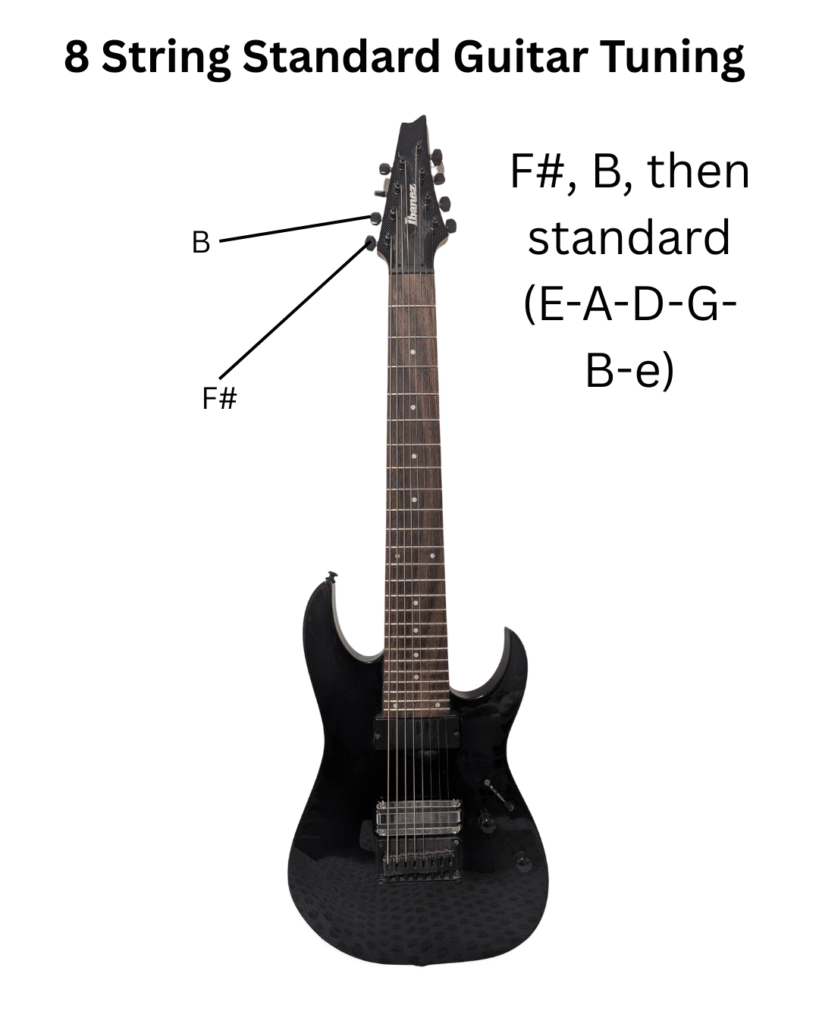
An 8-string guitar has two lower strings compared to a standard 6-string guitar. You’ll tune to F# on the 8th string (the lowest string), and B on the 7th string. The 6 strings tuned above them keep standard tuning (E-A-D-G-B-E).
This gives you the extended range desired for metal riffs, djent, and modern progressive music.
Other Common 8-String Tunings
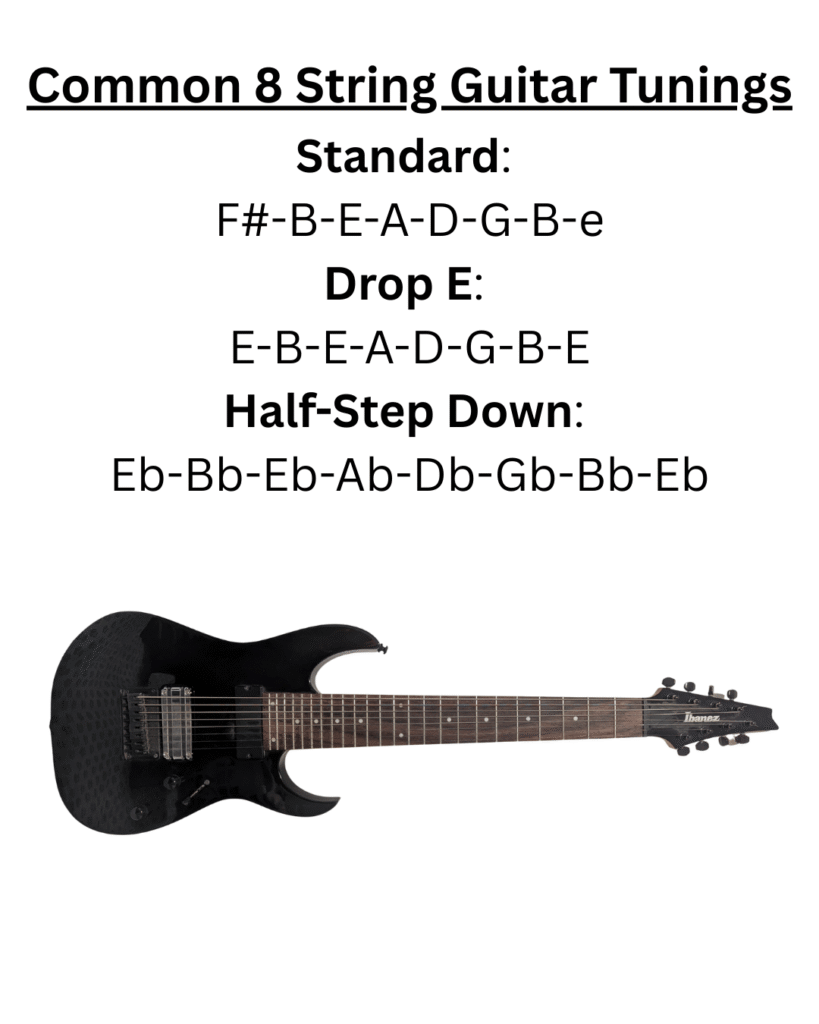
Drop E (E-B-E-A-D-G-B-E)
This tuning has a similar feel to drop D tuning, but it’s much heavier because of the 2 low strings.
Drop tunings make it easy to play barre power chords on the top 3 strings. And visualizing notes, chords, and scales on the 6 higher strings remains easy, because they maintain standard tuning.
Half-Step Down (F-Bb-Eb-Ab-Db-Gb-Bb-Eb)
Lots of traditional metal songs use the Eb standard tuning, especially in thrash metal and neoclassical metal.
This tuning is just like that, but with 2 lower strings!
String Gauge and Setup
For lower tunings, make sure your guitar has a proper setup. Either learn how to maintain your guitar, or take it to a professional luthier.
And, if your guitar is having trouble with its lower strings, it could be an issue with the bridge or the nut.
Last, consider a guitar with a longer scale length if you want to balance your string tension relative to the size of your strings.
Final Thoughts
Now you know how to tune an 8-string guitar!
You looked at 3 popular tunings for 8-string, but you’ll definitely find more tunings as you listen to more heavy metal bands who use extended range guitars.
Thanks for reading!